
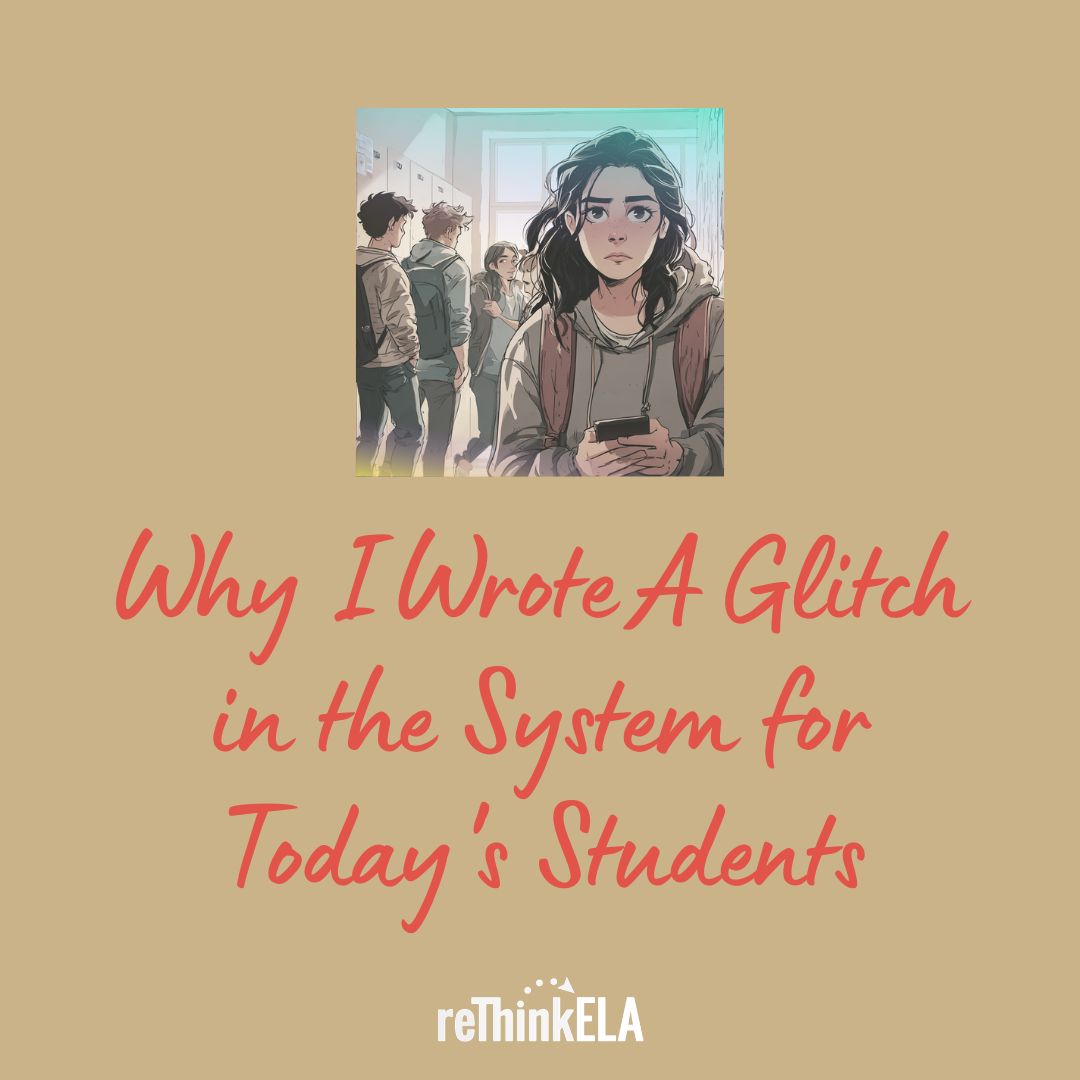
After teaching English for more than a decade, I've noticed something that has stayed with me.
Many of the students who quietly shape a classroom are almost invisible in the stories we ask them to read.
- The loud students often become the protagonists.
- The athletes become the heroes.
- The funny students become the comic relief.
The quiet students (the ones who spend lunch in classrooms, who build friendships online, who overthink every conversation, who notice everything but rarely announce themselves) often become background characters.
The irony is that many of those students are also extraordinary writers.
- They're observers.
- They're thoughtful.
- They're curious.
- They ask remarkable questions.
And when they finally feel safe enough to write honestly, they often produce some of the most memorable work I've ever read.
I wanted to write a story where one of those students gets to be the hero.
The Classrooms That Inspired the Story
Over the years, I've taught students from rural communities, suburban schools, and small Oklahoma towns. Now that I’m teaching first year composition at local universities, I’m meeting students from around the country. Although every school has been different, one thing has remained surprisingly consistent: teenagers are constantly navigating invisible social systems.
Most students understand those systems long before adults recognize them.
- They know where they're expected to sit.
- They know who belongs to which group.
- They know which interests are celebrated and which are quietly dismissed. (Just think about the difference between how the football team is celebrated on their way to the state championship game versus the academic team...)
Most importantly, they know how exhausting it can be to perform a version of yourself simply to survive another school day. (As a socially anxious teenager myself, I didn’t even try.)
A Glitch in the System grew out of years of watching students navigate those realities with far more resilience than adults often give them credit for.
Writing as a Place to Belong
One of the reasons I continue to believe so strongly in writing instruction is that writing gives students an opportunity to become the authors of their own identities.
In classrooms, we sometimes talk about voice as if it's simply a stylistic choice.
For many adolescents, voice is much more than that.
It's an act of self-discovery.
Throughout the story, Ro doesn't become more confident because someone rescues her. She becomes more confident because she keeps writing, keeps thinking, keeps helping other people tell their stories, and gradually discovers that her quiet way of moving through the world has value. (At least, that's what I've tried to convey...)
That matters.
Many students don't need to become louder.
They need opportunities to recognize that who they already are has something meaningful to contribute.
Why an English Classroom?
If you've read many of the articles on reThink ELA, you probably won't be surprised that the emotional center of this story is an English classroom. (I love stories that feature ELA, like The Poet X by Elizabeth Acevedo and The Trouble with Heroes by Kate Messner.)
English classrooms have always been different. They're one of the few places in school where students are invited to wrestle with questions instead of simply memorizing answers.
- They read lives unlike their own.
- They write about experiences that matter to them.
- They discuss complicated ideas with classmates whose perspectives differ from theirs.
- And, at their best, they become places where students can safely experiment with who they are becoming.
Mrs. Bridges represents the kind of teacher I strive to be: not perfect, but deeply committed to creating a classroom where every student has an opportunity to grow.
Why Gothic Literature?
The writing assignment embedded in my story is based on the creative writing unit I developed in my instructional design class and implemented in a colleague’s rural Oklahoma sophomore English class.
Beyond that, the answer is simple.
Gothic literature has never really been about monsters.
It has always been about environments.
- Old houses.
- Dark forests.
- Ancient curses.
- Hidden fears.
In adolescence, those environments often become something much more familiar.
- School hallways.
- Locker rooms.
- Cafeterias.
- Social media feeds.
The real "haunting" in A Glitch in the System isn't supernatural. It's the invisible pressure to perform a role that no longer fits.
Technology Isn't the Villain
In "There will Come Soft Rains" by Ray Bradbury, "The Machine Stops" by E.M. Forster, the Terminator movie series, and the I.Robot movie, technology ends up being the villain. One thing I intentionally wanted to challenge was the common narrative that technology is automatically harmful.
In my story, social media can certainly amplify cruelty. But digital spaces can also create belonging.
Ro's Discord community is a place where students tutor one another, brainstorm ideas, celebrate creativity, and remind one another that they are not alone.
Many of today's adolescents experience community in both physical and digital spaces.
Rather than dismissing those online communities, I believe we should help students think critically about how they build and sustain healthy ones.
Questions I Hope Students Discuss
More than anything, I hope this story encourages meaningful classroom conversations.
I want students to think beyond the worksheet that just asks in 10 separate multiple choice questions: "What happened?"
I want students to think about and discuss:
- Who gets to become the "main character" in a school community?
- How do labels shape our identities?
- When does helping someone become an act of courage?
- How does writing help us understand ourselves?
- What kinds of communities help people flourish?
- How can kindness quietly reshape an entire culture?
Those are questions worth exploring long after students finish the final page (or listen to the final minute, because listening to stories counts as reading, too).
Teaching A Glitch in the System
If you'd like to bring A Glitch in the System into your classroom, I've created a growing collection of companion resources through the Curated Short Stories Library.
Teachers will find:
- A printable classroom edition of the story (PDF)
- A free audio adaptation on YouTube for listening activities or absent students
- Carefully selected paired texts
- Discussion prompts
- Writing activities
- A growing collection of before, during, and after reading activities including graphic organizers
I designed these classroom-ready instructional materials specifically for middle and high school English language arts teachers. My hope is that these resources allow you to spend less time creating materials and more time listening to the conversations students have after they realize that someone like Ro can be the hero of a story.
Because if there's one thing I've learned after years of teaching, it's this: Our quietest students often have the loudest ideas.
Sometimes they simply need the right story to help them believe those ideas matter.
Curious About the Story Behind the Story?
Although I published A Glitch in the System under my pen name, Hollis Penley Reed, the inspiration behind the story is deeply personal. On my author website, I share how a favorite childhood novel, my own experiences with social anxiety, and years of teaching English all came together to shape Ro's journey and why I believe quiet, thoughtful students deserve to be the heroes of stories, too.
If you'd like a behind-the-scenes look at the writing process, the real-life influences behind the characters, and the creative decisions that shaped the story, I hope you'll visit my author site at HolllisPenleyReed.com.
Natalie, I love your emails. I do not believe you are still teaching in the classroom. Many of your thoughts are fantastic, but no appropriate or do-able in our classrooms. Most of us don't get to choose our literature; we have to use district approved texts. And yes, technology is the "villain" that is killing mastery in many of our students. They are not doing the work because "something" else will do it for them. What was once a valuable support has now become a crutch. If you were still teaching, you would see this first hand. Your credentials are so impressive, but every year a teacher is removed from a classroom setting, information becomes less and less applicable and relevant.
Hi Debi!
Thank you for taking the time to write such a thoughtful response. I honestly think we’re on the same side.
I agree with you that many teachers are working within district-approved or even scripted curricula. While that hasn’t been true in every school where I’ve taught or worked with teachers, it is the reality for many classrooms today, and I know how frustrating that can be.
I also agree that we’ve become too dependent on technology in many cases. Technology can be a wonderful tool, but it should never replace thinking, discussion, or writing. That’s one of the reasons I’m intentionally creating so many printable, discussion-based, and writing-focused resources. I want students doing the thinking—not outsourcing it.
One thing I should clarify is that I am still teaching. While I’m no longer a full-time middle or high school English teacher, I teach first-year composition at the university level, and my freshmen are only weeks removed from high school. I also work in writing centers, including helping develop a high school writing center, so I spend a great deal of time talking with students about the writing experiences that shaped them before they ever arrive in my classroom.
I’ve also made a point to stay connected to secondary classrooms by supervising pre-service teachers during their clinical experiences, working alongside veteran colleagues in their classrooms, and listening carefully to practicing teachers whenever I have the opportunity. Those conversations influence my work every day.
You’re right that some of what I write is aspirational. I’m not always creating resources for schools exactly as they are; sometimes I’m imagining what they could become and building resources that help teachers move in that direction, even in small ways. I know many teachers have very little flexibility, so I try to create materials that can supplement (not replace) the curriculum they’re required to teach.
One thing I’ve come to believe is that education needs all of us. Classroom teachers have insights that no one else can have because they’re living this work every day. At the same time, many of those same teachers don’t have the time or energy to create the resources they wish existed. My hope is to use the experience I’ve gained in the classroom, in writing centers, in teacher education, and now in higher education to help fill that gap while continuing to learn from the teachers who are doing the work every day.
So thank you for pushing back. Comments like yours remind me to keep listening, to keep learning, and to keep creating resources that are both practical and hopeful. We may not agree on every point, but I think we both want the same thing: classrooms where students read, write, think, and grow.
Take care of yourself!
Michelle