
There is a particular moment in virtually every middle school English language arts classroom when you realize your students are speaking English—and yet somehow you understand none of it. Like that day when I one of my students looked me straight in the eye and said, "Wow! Mrs. Waters, you're being salty today." (In retrospect, the kid was right.)
This this week though, a teacher, realizing she is about to face such a quandary, posted this question in a Facebook group recently:
“Now that I can smell the light fragrance of middle schoolers in the air, what slang should I know? I would like to give ‘em the ole razzle dazzle with some good ones, but I also want to be able to shut down the super inappropriate ones.”
First of all, I appreciate both goals.
There is something delightful about dropping a perfectly timed piece of student slang into a conversation just to watch an entire room of seventh graders recoil.
But there is also a legitimate classroom-management reason to know what students are saying.
That said, I wouldn’t recommend downloading a list of current middle school slang. By the time I finished writing one, some of it would probably already be outdated.
Meet Mr. Lindsay, middle school translator of student lingo
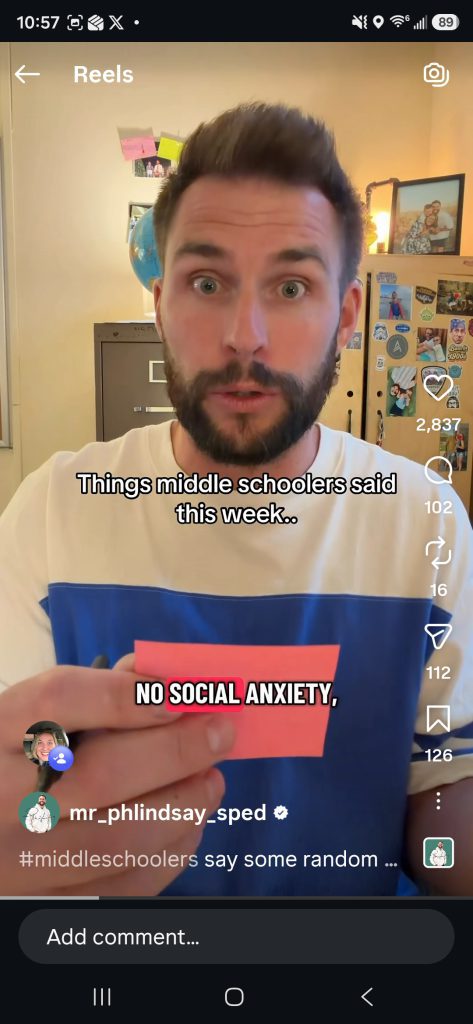
Instead, I recommend following Mr. Lindsay (@mr_lindsay_sped) on TikTok and Instagram.
Philip Lindsay is a middle school special education math teacher who has essentially become a translator between Generation Alpha culture and the adults trying desperately to understand it. His videos regularly explain the words, phrases, gestures, memes, and assorted “brain rot” currently making their way through middle school hallways.
And because he is actually teaching middle school students, he is often hearing these phrases in the wild rather than finding them on a list of “teen slang adults should know.”
That distinction matters.
Slang changes extraordinarily quickly. In 2025, students were yelling “six-seven,” often without any meaningful definition at all. More recently, Lindsay has documented phrases such as “city boy” and “call your Uber.” By summer 2026, he was already warning teachers about “quiet on the creek” potentially making its way into classrooms.
In other words, the language keeps moving.
If you want a quick introduction before disappearing down that particular social-media rabbit hole, you can also watch Mr. Lindsay explain student slang on the TODAY show.
You don’t actually need to speak it
There is an important nuance here, though. I don’t think teachers need to become fluent in middle school slang. Your students already have people with whom they can speak middle school. They need you to be their teacher.
Knowing their language is valuable because language tells us something about the communities students inhabit. Their slang carries humor, relationships, status, identity, insults, memes, music, gaming culture, social-media references, and countless inside jokes we may never fully understand.
That is where understanding the language helps you know when to laugh, when to ignore something, when to ask a student what they mean—and when to say, “No. We’re not using that word/phrase to talk about people.”
Language is part of classroom culture
For English teachers especially, there is another interesting opportunity here.
We spend a great deal of time teaching students that language changes according to audience, purpose, context, and community.
Middle school slang is a living example of exactly that.
Students already know how to code-switch between linguistic communities. They know that the language they use while gaming with friends is different from what they use when talking to their grandparents. They understand that one phrase can communicate belonging to one group and sound completely incomprehensible to another.
That’s rhetorical awareness. (This also reminds me of the time I told a student he couldn't do a backflip off my table because he might break his neck and his friend replied, "Aww... it'll buff! I suddenly realized this was an Oklahoma version of Monty Python's "'Tis but a flesh wound!")
We can acknowledge that linguistic expertise without pretending we belong to the same discourse communities they do. In fact, sometimes one of the best responses to unfamiliar student language is simply: “I have absolutely no idea what you just said. Explain it to me.”
You might get an eye roll.
You might get twelve students simultaneously shouting competing definitions.
But you also might learn something about the language—and the people—sitting in your classroom. And if you’d rather have someone else translate first while you’re preparing for the first days of school?
That’s what Mr. Lindsay is creating content for.
This is such a useful guide for teachers. Student slang changes so quickly that it can be hard to keep up, and understanding the context behind the words seems much more helpful than simply trying to ban them.