

We are hearing a great deal right now about students entering college with noticeable gaps in foundational reading, writing, and math skills.
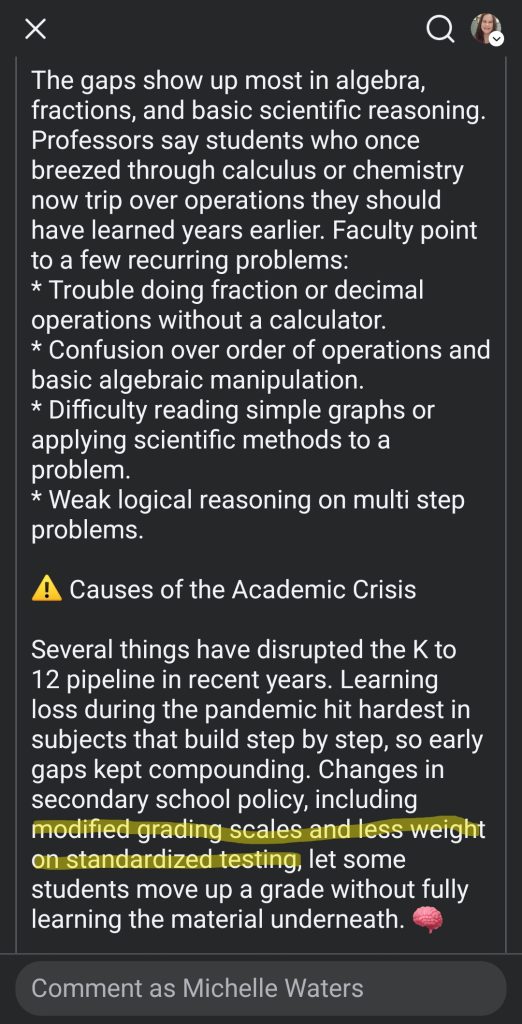
One recent article (see screenshot) placed much of the blame on secondary grading policies and the reduced emphasis on standardized testing. The argument was that modified grading scales and a reduced emphasis on standardized testing allow students to advance without mastering foundational material.
Grading policies certainly deserve thoughtful examination—but I do not believe they explain the whole problem. From what I have seen in both secondary English classrooms and first-year composition, the deeper issue is how high-stakes testing has reshaped curriculum and instruction over the past three decades.
When schools are pressured to produce measurable results, curriculum contracts. Teachers are expected to prioritize what will appear on the test, often at the expense of the extended reading, sustained writing, creative exploration, and critical synthesis that help students develop genuine fluency (Alston and Eagle, 2024; Au, 2007).
Some students entered my freshman composition courses having never written a rhetorical analysis. Others told me they had completed very few lengthy essays in high school. Students who had participated in International Baccalaureate programs were often the exception.
Knowledge also becomes fragmented. Reading and writing are divided into isolated standards, test targets, and prompt types. Students may learn how to identify a claim, select textual evidence, or answer a particular kind of question, but they do not always have enough opportunities to bring those skills together in a complex, sustained task.
I saw this when students struggled to transfer familiar skills into unfamiliar college assignments. They might understand each individual requirement, yet have difficulty deciding how the pieces worked together.
High-stakes pressure can also push instruction back toward teacher delivery, worksheets, and drill-and-practice. I once had a principal tell me to focus on the “meat and potatoes” of English language arts—and then ask whether I still had any workbooks in my classroom.
That conversation has stayed with me because it revealed a narrow definition of rigor: more practice with isolated skills rather than richer opportunities to read, discuss, question, write, revise, and create.
As Au’s (2007) research on high-stakes testing and more recent work by Alston and Eagle (2024) suggest, policies centered on narrow measures can lead to greater curricular control and fragmented learning. The result may look like coverage, but coverage is not the same as mastery. Students do not suddenly develop these gaps when they arrive on a college campus. They bring with them the cumulative effects of the educational systems they have experienced.
Addressing those gaps will require more than changing grading scales or adding another assessment. It will require giving teachers the time, trust, and curricular space to help students connect ideas, practice sustained inquiry, and use their knowledge in meaningful ways.
Educators:
- What are you seeing in your classroom?
- Are students’ gaps primarily the result of lenient policies—or the cumulative effect of a contracted, test-driven curriculum?
References
- Alston, C. L., & Eagle, J. L. (2024). Squeezed in: Writing Instruction Over Time. Journal of Literacy Research, 56(3), 190–212. https://doi.org/10.1177/1086296X241266854
- Au, W. (2007). High-Stakes Testing and Curricular Control: A Qualitative Metasynthesis. Educational Researcher, 36(5), 258–267. https://doi.org/10.3102/0013189×07306523