

Lately, I have fallen down a “What’s Up?” rabbit hole. I have replayed the 4 Non Blondes music video more times than I care to admit, watched interviews with Linda Perry, and listened to musicians and music fans from across the musical spectrum react to the song. I watched reactions from Beth Roars and The Charismatic Voice. Some focus on Perry’s unmistakable voice. Others talk about the emotion, the build, or the way the song seems to express something listeners recognize even when they cannot quite name it.
At some point during all that watching, my English-teacher brain took over.
I began wondering what would happen if we invited students to approach the song as a text. More than thirty years after its release, people are still discovering it, responding to it, and debating why it resonates. That staying power makes it more than a nostalgic song from 1993. It makes it a potentially powerful way to engage students in thinking about voice, conflict, frustration, identity, and the human need to understand what is happening around, and within, us.
I would not try to convince students the song is cool
The fastest way to lose middle and high school students may be to announce that a song from our own youth is still relevant to theirs. Instead, I would make that question part of the lesson.
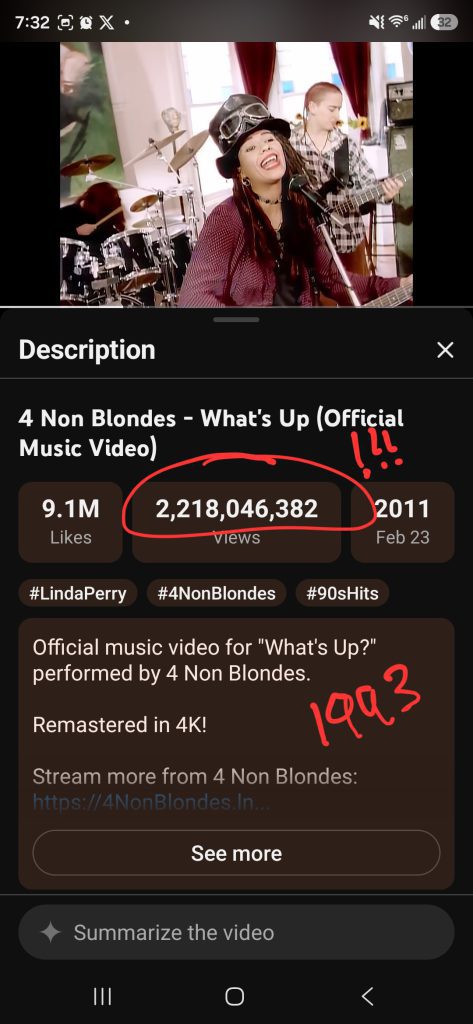
I might begin by telling students that What’s Up? was released in 1993, yet people continue to discover, revisit, and react to it. I’d show them that it (currently) has 2.2 billion views on YouTube.
Then I would ask:
Why do you think people still respond so strongly to this song?
Students would not need to like the song to participate in the conversation. In fact, their skepticism could become part of the inquiry. They could consider whether the song still feels authentic, whether its emotions seem exaggerated, and whether they know a more recent song that expresses similar frustration or uncertainty.
The goal would not be to persuade students that music from 1993 is better than the music they listen to now. The goal would be to help them recognize that people across generations use music, stories, and other forms of art to make sense of emotions they cannot always explain directly.
Reading the song as a text
Once students have listened, I would invite them to approach the song the same way we might approach a poem, monologue, or short story.
- Who is the speaker?
- What does she seem to want?
- What stands between her and that desire?
- Is the central conflict primarily internal, social, or something larger?
Perhaps most importantly, what does the speaker understand, and what is she still trying to understand?
The song is filled with emotional urgency, but it does not give listeners a neat explanation or resolution. That ambiguity is part of what makes it so useful in an English classroom. Students have to infer what the speaker is experiencing and support their interpretations with details from the song’s language, structure, repetition, and delivery.
They may arrive at different conclusions. Some may hear a personal crisis. Others may hear frustration with society, adulthood, expectations, or a world that does not make sense. Those differences create room for genuine discussion rather than a teacher-led search for one predetermined meaning.
A simple before-reading activity
I would use the song during the Engage phase of a short-story lesson (using the 5Es Instructional Model that I discuss in the Curated Short Stories Library).
Before revealing which story we were about to read, I would play the song and ask students to respond to a brief quick write:
What does the speaker believe is wrong? What details led you to that interpretation?
Students could then discuss their ideas with a partner or small group. As they listened to one another, they could add a second possibility to their original response.
That small addition matters. It reminds students that an interpretation can grow when they encounter another reader’s perspective.
After reading the short story, students could return to the quick write and consider how the protagonist might respond to the song. Would the character recognize the speaker’s frustration? Would the character disagree with her? Would the song give the character language for something they have not yet been able to express?
Connecting the song to "A Glitch in the System" by Hollis Penley Reed
My first instinct was to connect the song to my own short story, A Glitch in the System.
In the story, Ro recognizes that something about the social system surrounding her is not right, but understanding the problem does not immediately tell her what to do about it. Like the speaker in the song, she is caught between awareness and action.
The pairing could help students explore questions such as:
- What happens when we recognize that something is wrong but do not yet know how to change it
- When does expressing frustration become a form of resistance?
- How can writing help someone understand or challenge a system?
Students could compare the different ways the song and short story represent frustration. The song relies on voice, repetition, sound, and emotional escalation. The short story develops its ideas through character, conflict, dialogue, and narrative detail.
That comparison would help students analyze not only what the texts communicate, but also how different genres communicate meaning.
Connecting the song to “Through the Tunnel”
Doris Lessing’s “Through the Tunnel” offers another possible pairing.
Jerry cannot fully explain why swimming through the underwater tunnel matters so much to him. He knows that he wants to accomplish it, but his desire is tied to several overlapping needs: independence, belonging, maturity, recognition, and control.
The song could help students think about what it feels like to want change without being able to clearly define what that change should look like.
A guiding question might be:
How do people know whether a struggle is helping them grow or causing them harm?
Students could compare the speaker’s emotional struggle with Jerry’s physical and psychological struggle. They might also examine the role of repetition in both texts. Jerry returns to the tunnel again and again, just as the song’s speaker returns to the same unresolved questions.
In both cases, repetition reveals persistence, but it may also reveal desperation.
Connecting the song to “The Seventh Man”
Haruki Murakami’s “The Seventh Man” would create a more complex pairing centered on fear, memory, and emotions that resist easy explanation.
The narrator spends years attempting to understand an experience that shaped his life. He can describe what happened, but describing an event is not the same as understanding its emotional consequences.
The song similarly communicates powerful feelings without offering a complete explanation of its source.
Students might consider:
- Why can it be easier to describe what happened than to explain how it changed us?
- What happens when emotions remain unnamed or unresolved?
- Can telling a story change the power a memory holds over us?
The song could give students an accessible entry point into the story’s more abstract ideas about trauma, fear, guilt, and release.
Giving students space to bring their own music
I would not want the lesson to end with students analyzing only the song I selected.
After discussing What’s Up? and the short story, I would ask students to identify a more recent song that explores a similar conflict, emotion, or question. They could write a short explanation, create a playlist with annotations, record a brief podcast response, or design a visual comparison.
That invitation shifts students from consumers of the teacher’s selection to curators of their own textual connections.
It also communicates an important idea: the music they listen to already contains speakers, conflicts, symbols, patterns, arguments, and unanswered questions. Literary analysis is not a school-only activity. It is one way of paying closer attention to the texts that already surround us.
Resources for teaching these stories
You do not need to build an entire unit around the song. It could function as a quick write prompt, a discussion starter, an essential-question connection, a bridge into a final writing assignment, or a way to hook students into a story that is serving as a tool to engage students into a larger novel reading unit.
Inside the Curated Short Stories Library, you can find resources for teaching “A Glitch in the System” by Hollis Penley Reed, “Through the Tunnel” by Doris Lessing, and “The Seventh Man” by Haruki Murakami, including essential questions, writing prompts, paired-text ideas, and activities that can be adapted to fit this song connection.
What I keep coming back to
Perhaps the reason people continue responding to What’s Up? is not that everyone interprets it in exactly the same way. Perhaps it endures because so many listeners recognize the feeling at its center: the sense that something is happening within us or around us, and we are still searching for the language to name it.
That is also why we read stories.
Stories do not always give students answers. Sometimes, they give students characters, images, questions, and language that help them examine what they have already begun to notice.
And sometimes, an unexpected song from 1993 can open the door.
Watch and listen
Explore these connections in the Curated Short Stories Library
Members of the Curated Short Stories Library can use the links below to access the complete teaching resources for each story:
- "A Glitch in the System" by Hollis Penley Reed — Explore resources for teaching voice, social systems, resistance, and the power of writing.
- "Through the Tunnel" by Doris Lessing — Explore resources for teaching identity, persistence, belonging, and transformation.
- "The Seventh Man" by Haruki Murakami — Explore resources for teaching fear, memory, trauma, and emotional release.
Already a member? Make sure you are logged in to the Library before opening the story links. If a link takes you to the login page, log in, and then return to this article to select the story again.
Not a member yet? Learn more about the Curated Short Stories Library and gain access to these stories, accompanying teaching resources, and a growing collection of complete short texts for middle and high school English classrooms.