

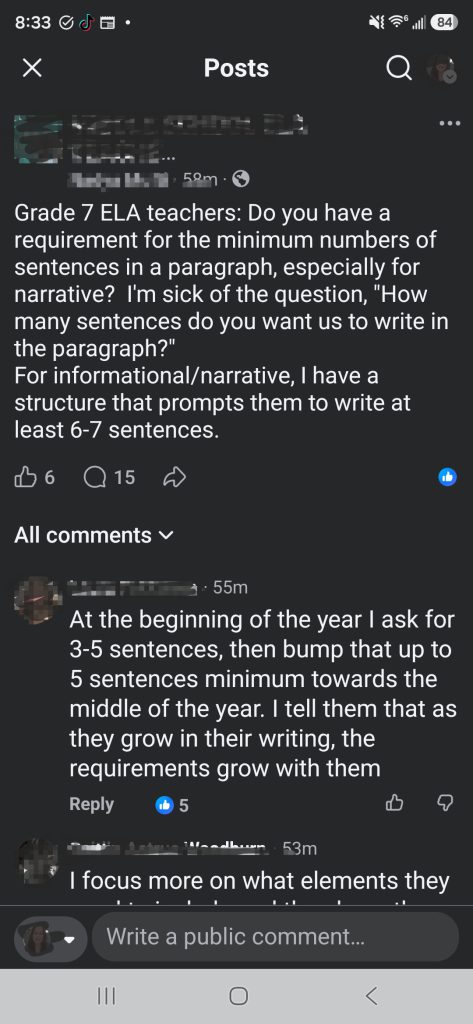
I recently saw a middle school teacher ask how others respond when students repeatedly ask, “How many sentences do you want in the paragraph?”
I understand the frustration. Students often want a number because a number feels safe. If the teacher says six sentences, they know exactly when they are finished. But when my high school students asked me that question, I usually answered with another one:
“How would you order a birthday cake?”
Think about it: Would you tell the baker what flavor you wanted, how many people the cake needed to serve, and what colors or theme it should represent?
Or would you tell the baker that you wanted a cake containing two cups of sugar?
Students were usually confused by the question at first. Then I explained that asking how many sentences belong in a paragraph is a little like ordering a birthday cake by specifying the amount of sugar.
The sugar matters. But it does not tell the baker what kind of cake you need.
In the same way, the number of sentences matters less than what the paragraph needs to accomplish. Writers should begin with the message, audience, and purpose. Once they understand what they are trying to communicate, they can determine what information the reader needs and how the paragraph should be crafted.
Of course, telling developing writers simply to “write until the paragraph is finished” is not always enough. Some students need a structure that helps them understand what a complete paragraph might include.
For an informational or argumentative paragraph, I might ask students to begin with a sentence that establishes the paragraph’s main idea or claim. They can then provide relevant details, examples, facts, or textual evidence. After presenting that information, they need to explain its significance: How does the evidence support the claim? What should the reader understand from it? Depending on the paragraph’s position in the larger piece, the writer may conclude the idea, connect it to the overall argument, or transition to what comes next.
That structure might result in six or seven sentences. It might also result in four carefully developed sentences or 10 sentences that guide the reader through a more complicated idea. The structure provides a starting point, not a sentence quota.
Narrative paragraphs work differently. A paragraph in a personal narrative or short story may develop a moment, action, image, exchange of dialogue, shift in time, or change in focus. A one-sentence paragraph can slow the reader down or emphasize an important realization. A longer paragraph might immerse the reader in a setting or unfold a sequence of events. Narrative writers make paragraphing decisions based on pacing, clarity, emphasis, and the reader’s experience—not because every paragraph must contain the same number of sentences.
Sentence requirements can be useful temporary scaffolds, especially for students who have not yet learned how to develop an idea. But the scaffold should help students notice what effective writing does. It should not become the definition of effective writing.
Our goal is not to train students to count sentences until they reach a pre-determined number.
Our goal is to help them recognize when they have given their readers what they need.