

During my recent first-year composition orientation, one idea kept following me home: delayed argumentation.
I immediately thought about conversations I’ve had with students at several grade levels, including college freshmen, about how they approach research-based arguments. Many describe essentially the same process: decide what they believe (or choose a side), search for sources that support it, gather enough evidence to prove the point, and write the paper.
They understand the structure of the argument. They know they need a claim, evidence, reasoning, and perhaps a counterargument. What I began wondering during orientation was whether we ask them to make those decisions too early.
What would happen if we moved the thesis later?
When students begin research with a position already established, sources can easily become evidence-gathering tools. I don't want students to ask "What can I find that supports my argument?" I want them to start with: "What do I need to understand?"
That means identifying the people involved, examining the context surrounding an issue, considering different interpretations of the evidence, and learning why people might see the same situation differently. Research should have the possibility of complicating students’ thinking. They may eventually arrive at the same position they held at the beginning, change their minds entirely, or discover that the original question was much more complicated than they realized.
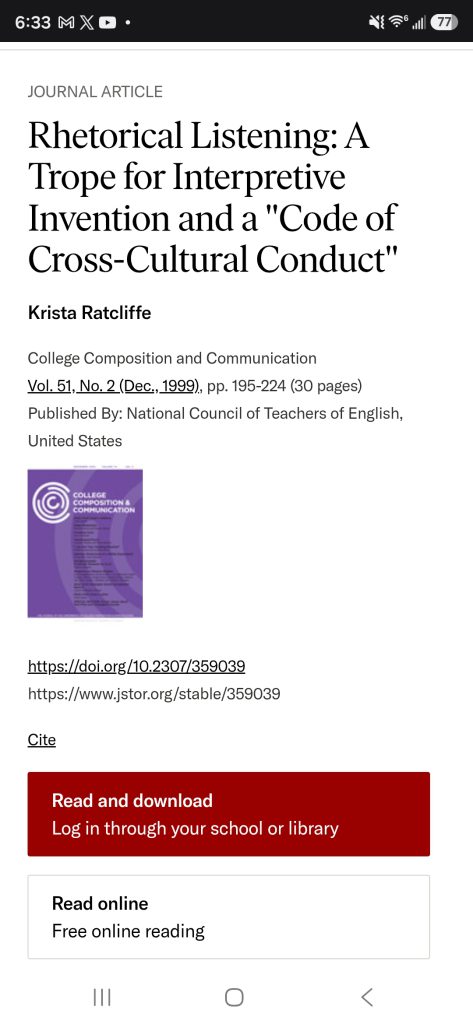
Ratcliffe (1999) gives us useful language for this through her concept of rhetorical listening, an active interpretive practice that asks people to approach others’ discourse with openness and work toward understanding the cultural logics and experiences beneath it. For the English classroom, that means we can treat understanding someone else’s argument as an intellectual task in its own right.
Students can ask what someone actually believes, what evidence they use, what experiences or values shape their perspective, and where different stakeholders agree or disagree. At that stage, agreement is unnecessary. The work is understanding the conversation well enough to enter it thoughtfully.
Kuhn and Crowell’s (2011) research with adolescents also gives me reason to take this idea seriously. They found that students who spent sustained time in dialogic argumentation later produced stronger individual arguments and developed a greater awareness of the relationship between evidence and claims. Earlier research by Kuhn and Udell (2003) similarly found that collaborative argument practice helped adolescents develop more sophisticated argument strategies, including counterargument.
Those ideas have me reconsidering the sequence in which we teach argument. I’m increasingly interested in something like:
- Wonder/Ask questions
- Investigate
- Listen (to the ongoing conversations)
- Complicate (What am I missing?)
- Evaluate
- Decide
- Respond
Students still need to learn how to construct claims, choose evidence, reason effectively, address counterarguments, and make rhetorical choices. But perhaps some of that work should come after they have spent enough time understanding the conversation they want to enter.
References
- Ratcliffe, K. (1999). Rhetorical listening: A trope for interpretive invention and a “code of cross-cultural conduct.” College Composition and Communication, 51(2), 195–224.
- Kuhn, D., & Crowell, A. (2011). Dialogic argumentation as a vehicle for developing young adolescents' thinking. Psychological Science, 22(4), 545–552.
- Kuhn, D., & Udell, W. (2003). The development of argument skills. Child Development, 74(5), 1245–1260.