
I wrote about this topic last month in Field Note #14: Reading Logs Do Not Build Readers, but a teacher recently posted the following question. It’s such a familiar one that I had to address it again:
My admin, a former ELA teacher, told me free reading and activities like First Chapter Friday are a waste of instructional time… How would you handle that?
I have been on the receiving end of a version of that comment. Years ago, when I was teaching secondary English, I had a principal question the value of the independent reading time I had built into my classroom. After a group of mechanically and athletically inclined students scored lower in reading than their previous academically-inclined class, he (a former math teacher) suggested that I return to the “meat and potatoes” of teaching literacy and asked if I still had any workbooks in my classroom. I understand where he was coming from. Looking in from the outside, independent reading can look deceptively simple: students sitting quietly with books while the teacher appears to be doing very little.
That conversation forced me to think more carefully about what I wanted independent reading to accomplish and how I could structure it to make that learning visible. That thinking eventually became Reading TRIIPS.
Reading time alone was not enough
I already believed students needed time to read. What I realized was that I needed a stronger structure around that reading so I could see what students were learning and where they were struggling. I did not want to replace reading with worksheets, quizzes, or elaborate book reports. I wanted to provide students' independent reading time with a framework to give me useful information.
I needed to know:
What books were students choosing?
Could they sustain their attention?
Were they abandoning books repeatedly?
Could they explain what was happening in their chosen text?
Were they making connections, asking questions, noticing patterns, or thinking about characters and ideas?
Could they talk about what they were reading?
Were they beginning to understand themselves as readers?
Once I began looking at independent reading this way, that time changed from free reading to structured reading that became an opportunity for formative assessment.
Independent reading can show us what students need
This matters especially in secondary classrooms because “struggling reader” can describe very different students. One high schooler may have difficulty decoding words. Another may read fluently but struggle with complex sentences. Another may comprehend well but have very little reading stamina. Another may be perfectly capable of reading grade-level texts but has spent years deciding that reading is boring or simply something they do not do.
Those students do not need the same instruction.
A structured independent reading system gives us a chance to notice those differences. Students' book choices, reading habits, student conversations, teacher conferences, written reflections, and responses can provide evidence of what they can already do and where they may need support. That evidence gives teachers something more useful than a label or test score: a clearer picture of the student as a reader.
That is why I created Reading TRIIPS
Reading TRIIPS grew out of my attempt to solve this exact instructional problem. I wanted students to read books they chose while still giving me enough structure to monitor their growth. I needed a system that would create artifacts of learning without requiring students to constantly stop reading in order to prove that they had read.
The goal was to give students meaningful stretches of time to read while also creating opportunities for reflection, conversation, writing, and response. Those artifacts helped me see patterns I could not always see through whole-class novels and comprehension tests alone.
I could ask:
Is this student choosing books that are too difficult or too easy?
Is the student reading steadily or avoiding the work?
Can the student summarize but not interpret?
Does the student have strong ideas about a book but struggle to explain them?
What do the student's book choices tell me about their interests and motivations?
Those are questions I can use to make instructional decisions.
First Chapter Friday can make book discovery visible, too
I think about First Chapter Friday in much the same way. I used the routine to introduce students to books they might never have picked up on their own, especially genres, authors, subjects, and writing styles outside their usual reading habits. For students who say they “don’t like reading,” the problem is sometimes that they simply have not found the kinds of books they want to read yet.
But I ran into a familiar problem: after I finished reading the first chapter, I could not always tell what students were thinking. Were they interested? Confused? Making connections? Predicting what might happen next? Would they actually want to keep reading the book?
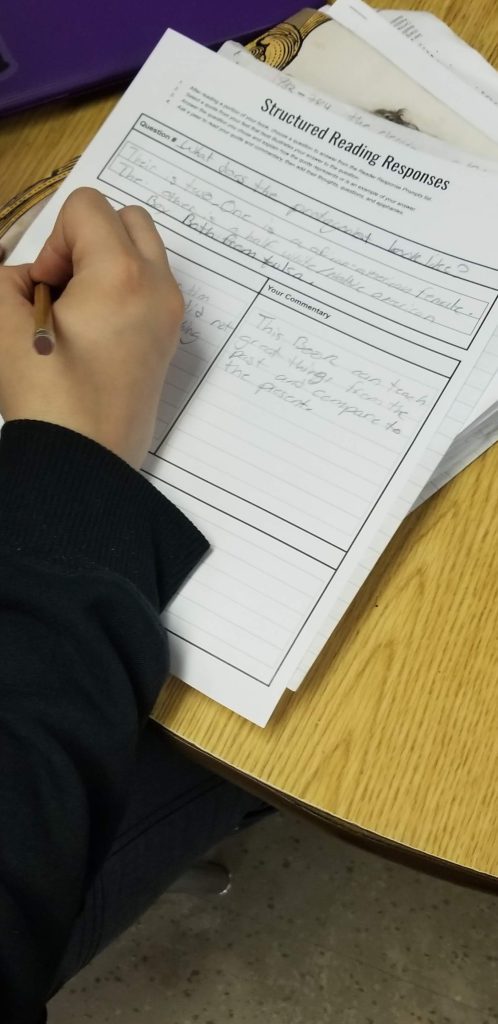
That is why I created my First Chapter Friday Graphic Organizer. It uses the Reading TRIIPS response strategy (Tie-Ins, Reactions, Inferences, Inquiries, and Predictions) to give students a brief, structured way to respond to what they have heard. Instead of requiring a lengthy journal entry, students can choose the kind of thinking that makes the most sense to them and create a small artifact that shows me how they are engaging with the text.
The goal is still to help students discover books they may want to read. The organizer simply gives me a better window into what is happening during that process. Like independent reading itself, First Chapter Friday becomes more useful instructionally when I can see enough of students’ thinking to decide what they may need next.
Making the learning visible in independent reading activities
Schools understandably rely on visible evidence of learning. Administrators see assignments, grades, notebooks, assessments, and data. Independent reading can create those artifacts too through reading records, short reflections, conferences, peer discussions, essential-question responses, and other brief pieces of evidence.
We need to make sure, though, that we’re not just creating more paperwork so we can prove students were busy. Our goal is to collect enough evidence to understand what students are doing as readers and make better instructional decisions because of it. That distinction changed the way I approached independent reading and eventually led me to develop my Reading TRIIPS Structured Independent Reading System.
If an administrator told me today that independent reading was a waste of instructional time, I would not simply defend the amount of time students spend reading. I would show what I am learning because they are reading: the patterns I am seeing, the conversations we are having, the artifacts students are creating, and the instructional decisions I am making in response.
That same principle is behind my free First Chapter Friday Graphic Organizer, which gives students a brief way to make their thinking visible after listening to the beginning of a new book.
When independent reading is intentionally structured, students still get the time and choice they need to become stronger readers, while teachers gain the evidence we need to understand where students are and help them decide where to go next.