
Have you spent the summer thinking about how you’re going to revise the curriculum you’ve been using the past several years — and then found out at almost the last minute that you’ll be teaching a completely different grade?
My friend and colleague told me about this a couple of days ago. She has been teaching juniors and seniors for years and will now be teaching (You guessed it!) high school freshman.
So she called me and we began comparing ideas for helping younger students settle into the routines and expectations of the English classroom during the first week of school.
I told her about how I ask them to think beyond the usual get-to-know-you questions:
- What goals do you have for yourself this year?
- What do you hope to learn in this class?
- What kind of grade are you working toward?
- What might make it difficult for you to reach those goals?
- How can I support you?
In the past, when I’ve looped with students, I’ve given them this task as part of a Google Form with text areas for them to write their answers. But when I have students who are new to me, I prefer to use a quick write, written by hand. This way, students can go back and add more details that I need to know as we get to know each other over the course of a few days or weeks.
These responses give me information that a student interest survey alone cannot always provide. Students begin telling me how they see themselves as learners: what they want, what they fear, what they believe they can accomplish, and sometimes what has made school difficult for them in the past.
I keep those quick writes.
Later in the semester, when a student feels discouraged or begins disengaging, I can pull the response back out and say, “At the beginning of the year, you told me this was important to you. Is it still important? What has changed? What do you need from me?”
The quick write does not become a contract I use against the student. Goals change. Circumstances change. Teenagers change (Sometimes dramatically!) over the course of a semester. Instead, the writing becomes a starting point for a conversation. It reminds both of us that the student entered the room with hopes and intentions, even if those intentions have temporarily become buried beneath frustration, exhaustion, fear, or a string of missing assignments.
Then my friend shared a small adjustment that made the entire routine even more useful.
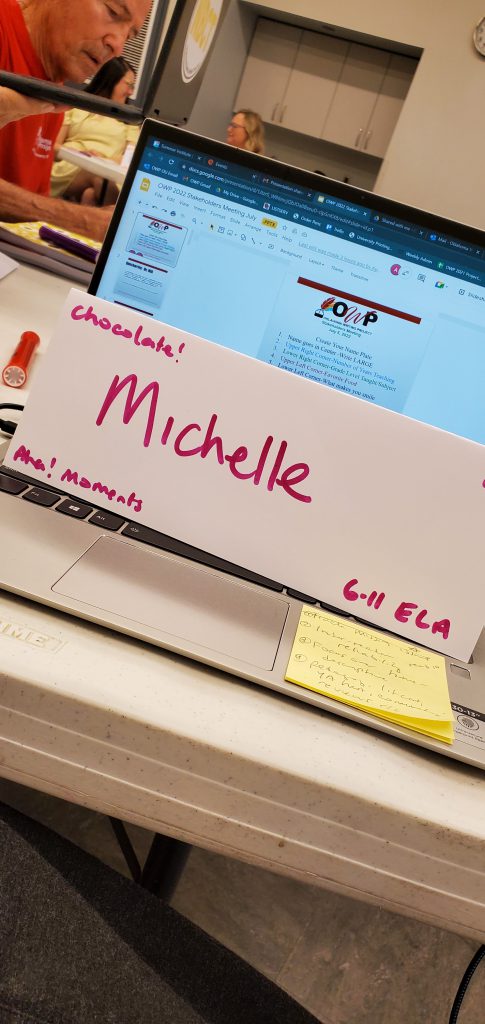
She has students attach their quick write to the back of the name tent they use during the first week of school. Students turn in their name tents at the end of each class period, and she passes them back out the next day.
I immediately loved this idea.
During those first few days, when we are trying to learn more than a hundred names while answering schedule questions, introducing routines, troubleshooting technology, and helping nervous students find their place in the room, the name tent becomes more than a name-learning tool.
It becomes a small, portable student profile.
As you distribute or collect the tents, or while you’re planning your lessons, you can revisit what each student has written. You can notice that one student wants to become a more confident writer, another is worried about maintaining a certain grade, and another simply hopes to participate more without feeling embarrassed. Another one maybe has already given up hope, but is hiding it behind bravado or a funny answer.
Those details can shape the conversations we have from the beginning.
- “You mentioned that speaking in class makes you nervous. Would it help if I gave you time to write before discussions?”
- “You said you want to improve your grade in English this year. Let’s talk about what helped—or did not help—last year.”
- “You wrote that you want to become a better storyteller. I think you’re going to enjoy what we’re doing next week.”
These are small comments, but they tell students something important: I read what you wrote. I remember what matters to you. I am paying attention.
The routine also models an idea I want students to understand about writing: Their words can continue to matter after an assignment has been submitted. Writing can preserve a thought, begin a conversation, and help us return to an earlier version of ourselves. We can see how much we’ve grown, or rediscover a more hopeful vision that we once held.
Of course, the name tents will eventually come down. Students will learn the room, and we will learn one another’s names. When that happens, the goal quick writes can move into a folder, student portfolio, or other place where they can be revisited later.
But during the first week, these goals help us begin the year by seeing students not merely as names on a roster or scores in a gradebook, but as people who have entered our classrooms carrying hopes and dreams of their own.
And perhaps that is one of the most important things we can accomplish during the first days of school.
For more ideas for building purposeful routines and relationships at the beginning of the year, read my most recent first days of school article and resources.